Methods in Arrays – Part 1

Arrays topic in TypeScript is divided into following parts:

Below are the methods that are discussed in this section

concat every filter
forEach indexOf join
concat

This contacts two or more arrays and returns a new array.
Syntax

array1.concat(array2, array3,...);

Below is a sample code

var nums:string[] = new Array("10","20","30");
var chars:string[] = new Array('a','b','c');
var strings:string[] = new Array("Hello","Hi");
var i:number;
var newArray = strings.concat(chars, nums);
for(i=0; i<newArray.length; i++){
    console.log(newArray[i]);
}

Below is the output of above code

every

This method tests whether all array elements passes the test implemented by the function.
Returns true is all the array elements passes in the function test, otherwise false.
functionName is the name of the function used to test the array elements
Syntax

arrayName.every(functionName);

Below is a sample code

// returns true
function test1(element, index, array) { 
    return (element >= 10); 
 } 
 var nums1:number[] = [10,20,30];
 var result1 = nums1.every(test1); 
 console.log("Test Value : " + result1);

 // returns false
 function test2(element, index, array) { 
    return (element > 10); 
 } 
 var nums2:number[] = [10,5,30];
 var result2 = nums2.every(test2); 
 console.log("Test Value : " + result2 );

Below is the output of above code

filter

This function will create a new array with the elements that passes a test implemented by a function.
Returns a new array
functionName is the name of the function used to test the array elements
Syntax

arrayName.filter(functionName);

Below is a sample code

function even(element, index, array) { 
    return (element%2 == 0); 
 } 
 var nums1:number[] = [5,10,20,30,105,64];
 var result1 = nums1.filter(even); 
 console.log("Even Numbers: " + result1);

Below is the output of above code

forEach

This method calls a function for each element in the array.
Syntax

arrayName.forEach(funcionName)

Below is an example

let users = ["Akanksha","Aarav","Anita","Raj"];
users.forEach(function(value){
    console.log(value);
});

Below is the output of above code

indexOf

This method will return the first index in which the element is found. It will return -1 if the element is not found.
Returns the first index in which the element is found. It only returns one index even if the value is present at multiple indexes
value: the value which we are looking in the array
fromIndex: the index from which we want to start the search. This is optional. By default, it will start the search from the beginning of the array.
Syntax

arrayName.indexOf(value, [fromIndex[);

Below is an example

var nums:number[] = [10,20,30,20,40,50,10];
console.log("Original array: " + nums);
console.log("Search for value 20: " + nums.indexOf(20));
console.log("Search for value 20, search start from 2nd index: " + nums.indexOf(20,2));
console.log("Search for 50: " + nums.indexOf(50));

Below is the output of above code

join

This method joins all the array elements into a string. We can pass a custom separator which can be used to separate the array values in the string. By default, it will use comma (,) as a separator.
Syntax

arrayName.join(separator);

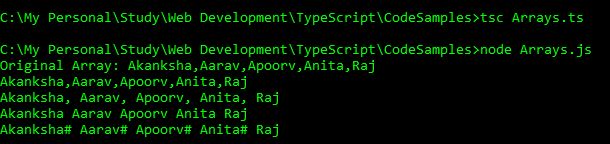
Below is an example

var users:string[] = ["Akanksha","Aarav","Apoorv","Anita","Raj"];
console.log("Original Array: " + users);
console.log(users.join());
console.log(users.join(", "));
console.log(users.join(" "));
console.log(users.join("# "));

Below is the output of above code
Array Objects

Arrays topic in TypeScript is divided into following parts:

Array Objects

We can use Array object to create arrays. We can use Array constructor to pass array values. We can pass values in two ways:
– If we pass a numeric value to the constructor, it represents the size of the array
– Multiple values separated by comma represents the elements of the array
Syntax

var arrayName:dataType = new Array();

Below is an example, where we declare an Array object, assign values to it and then retrieve those values. You can use for loop as well to assign value to array.

var num:number[] = new Array(3);
var i:number;
num[0] = 10;
num[1] = 20;
num[2] = 30;
for(i=0;i<num.length;i++){
    console.log(num[i]);
}

Below is the output of above code

Let’s pass element values to Array Constructor.
Below is an example

var num:number[] = new Array(10,20,30);
var i:number;
for(i=0;i<num.length;i++){
    console.log(num[i]);
}

Below is the output of above code

Introduction to Arrays in TypeScript

Arrays topic in TypeScript is divided into following parts:

Introduction to Arrays
  • When we store a value, we declare a variable and assign the value to that variable. This variable takes a random place in the memory. But if we want to store 100 values of same type, like userNames, we have to declare 100 variables which will take 100 random places in memory. Hence using variables in this scenario is not feasible.
  • We use Arrays for this scenario. An Array is a collection of values of same data type.
  • Arrays are allocated sequential block of memory. Each memory block represents an array element.
  • We cannot resize the arrays once they are initialized.
  • We access array elements using an index. Array index starts with 0(zero). That means, first element of array is stored at the index 0.
  • Arrays should be declared before they are used. Variable name of arrays follow the rules for declaring a variable.
  • We can update an array element’s value, but we cannot delete it.
  • Array population means initializing the array elements with the values.
  • If you do not provide the data type to array variable, it will take any data type.
Declaring and Initializing an Array

Syntax

// Declare and initialize Array in different statements
var arrayVariable:dataType[];
arrayVariable = [value1, value2, value3,...];

// Declare and initialize Array in one statements
var arrayVariable:dataType[] = [value1, value2, value3,...];

Below is a an example

// Declare Array and then initialize it
var users:string[];
users = ["Akanksha","Aarav","Anita","Raj"];

// Declare Array and initialize it in the same line.
var users1:string[] = ["Akanksha","Aarav","Anita","Raj"];
Accessing Array Elements

Array elements are accessed using indexes. Index for array starts with 0. We can use loops as well to access the array elements.
Syntax

arrayVariable[index];

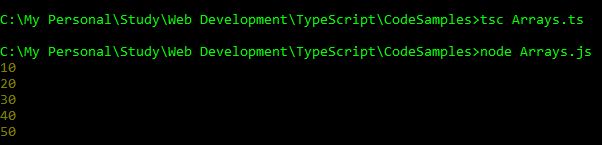
Below is an example

var values:number[] = [10,20,30,40,50];
console.log(values[0]);
console.log(values[1]);
console.log(values[2]);
console.log(values[3]);
console.log(values[4]);

Below is the output of above code

Using for loop to access Array elements
Below is an example

var values:number[] = [10,20,30,40,50];
var i:number;
for(i=0; i&lt;values.length; i++){
    console.log(values[i]);
}

Below is the output of above code

Using for…in loop to access Array elements
Below is the sample code

var values:number[] = [10,20,30,40,50];
var val:any; // make sure this data type is any
for(val in values){
    console.log(values[val]);
}

Below is the output of above code

Strings in TypeScript – Part 3

Strings in TypeScript is divided in three parts:

This section has the details of following methods:

toLocaleLowerCase toLocaleUpperCase toLowerCase
toUpperCase toString valueOf
toLocaleLowerCase()

This method will convert all the characters of a string in lower case representing the current locale.
Syntax

string.toLocaleLowerCase();

Below is a sample code

var str1 = new String("I like to eat MANGOES, WHICH are YELLOW in color");
console.log("Original String: " + str1);
console.log("Lower-case String: " + str1.toLocaleLowerCase());

Below is the output of above code

toLocaleUpperCase()

This method will convert all the characters of a string in upper case representing the current locale.
Syntax

string.toLocaleUpperCase();

Below is a sample code

var str1 = new String("I like to eat MANGOES, WHICH are YELLOW in color");
console.log("Original String: " + str1);
console.log("Upper-case String: " + str1.toLocaleUpperCase());

Below is the output of above code

toLowerCase()

This method will convert all the characters of a string in lower case.
Syntax

string.toLowerCase();

Below is a sample code

var str1 = new String("I like to eat MANGOES, WHICH are YELLOW in color");
console.log("Original String: " + str1);
console.log("Lower-case String: " + str1.toLowerCase());

Below is the output of above code

toUpperCase()

This method will convert all the characters of a string in upper case.
Syntax

string.toUpperCase();

Below is a sample code

var str1 = new String("I like to eat MANGOES, WHICH are YELLOW in color");
console.log("Original String: " + str1);
console.log("Upper-case String: " + str1.toUpperCase());

Below is the output of above code

toString()

This method returns the string representing the specified object. You can perform all the string operations on this converted object.
Syntax

object.toString();

Below is a sample code

var str1 = "I like to eat MANGOES, WHICH are YELLOW in color";
console.log("Original String: " + str1);
console.log(str1.toString());

Below is the output of above code

valueOf()

This method returns the primitive value of the String Object.
Syntax

string.valueOf();

Below is a sample code

var str1 = "I like to eat MANGOES, WHICH are YELLOW in color";
console.log("Original String: " + str1);
console.log(str1.valueOf());

Below is the output of above code

Strings in TypeScript – Part 2

Strings in TypeScript is divided in three parts:

This section has the details of following methods:

subString subStr split
slice search replace
match localeCompare lastIndexOf
lastIndexOf()

This method returns the last index of a specified value within a string. Search will start from the starting of the string. variable is the string in which we are searching for the value.
searchString is the value which we are searching in the variable.
fromIndex is an integer which specify the starting index for the search. It will return -1 if the string is not found.
Syntax

variable.lastIndexOf(searchString, [fromIndex])

Below is a sample code

var str1 = new String("This is a sample string sample");
console.log("Last Index of i: " + str1.lastIndexOf('i'));
console.log("Last Index of is: " + str1.lastIndexOf("is"));
console.log("Last Index of sample: " + str1.lastIndexOf("sample"));
console.log("Last Index of sample: " + str1.lastIndexOf("sample", 14));
console.log("Last Index of two: " + str1.lastIndexOf("two"));

Below is the output of above code

localeCompare()

This method will return an integer value after sorting two strings
Syntax

str1.localeCompare(str2);

– Returns 0 if str1 and str2 are equal.
– Returns 1 if str2 comes before str1 in the locale sort order.
– Returns -1 if str2 comes after str1 in locale sort order.

Below is an example

var str1 = new String("ab");
var str2 = new String("cd");    
var index1 = str1.localeCompare("ab");  
var index2 = str2.localeCompare("ab");  
var index3 = str1.localeCompare("cd"); 
console.log("Perfect Match: " + index1 );
console.log("Parameter value comes before the string value: " + index2 );
console.log("Parameter value comes after the string value: " + index3 );

Below is the output of above code

match()

This method searches a string for a match against a regular expression. This will return an array of all matches. Include g modifier to do a global search, that is in complete string. Otherwise it will return only the first match in the string. i is used to match without case-comparison. This method will return null if no match is found.
Syntax

variable.match(regexpre);

Below is an example

var str1 = new String("This is an example. ThiS IS good.");
console.log(str1.match(/is/g));
console.log(str1.match(/is/gi));

Below is the output of above code
replace

This method first finds a match between a regular expression and a string, then replaces the matched substring with another substring.
Syntax

variable.replace(regexp, substring);

Below is a sample code

var str1 = new String("I like to eat mangoes, but mangoes only come in summers. Mangoes are yellow in color.");
var result = str1.replace(/mangoes/gi,"apples");
console.log(result);

Below is the output of above code

This method searches a substring, using a regular expression, within a string and returns the index.
If the regular expression is not inside the string, it will return -1.
Syntax

string.search(regexp);

Below is a sample code

var str1 = new String("I like to eat mangoes, but mangoes only come in summers. Mangoes are yellow in color.");
var index = str1.search(/mangoes/gi);
console.log("First index of mangoes: " + index);

Below is the output of above code

slice()

This method extracts a section of a string and returns a new string. You can remove characters from beginning as well as from the end of the string. Giving the value fromEnd is optional.
Syntax

string.slice(fromBeginning, [fromEnd]);

Below is an example

var str1 = new String("I like to eat mangoes, but mangoes only come in summers.");
console.log(str1.slice(4,-5));

Below is the output of above code

split

This will split a string into array based on a substring. This method returns an array.
separator is the substring used to split a string.
limitOfValues is an integer value that tells how many values to return.
Syntax

string.spli(separator, [limitOfValues])

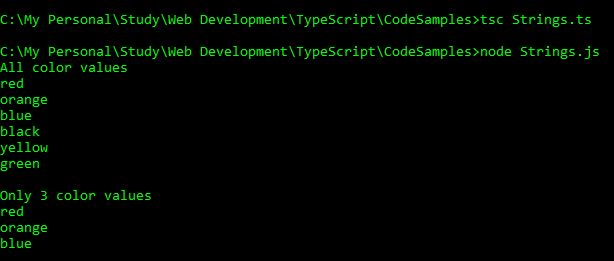
Below is an example

var str1 = new String("red,orange,blue,black,yellow,green");
var colors = str1.split(',');
var i:number;
console.log("All color values");
for(i=0; i<colors.length; i++)
{
    console.log(colors[i]);
}
var colors1 = str1.split(',',3);
var i:number;
console.log("\nOnly 3 color values");
for(i=0; i&lt;colors1.length; i++)
{
    console.log(colors1[i]);
}

Below is the output of above code

substr()

This method will return a new string.
startIndex represents the index from where we want to start extracting the substring.
length is a number representing the number of characters we want to extract. This is optional.
Syntax

string.substr(startIndex, [length]);

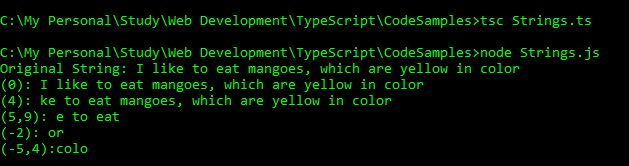
Below is a an example

var str1 = new String("I like to eat mangoes, which are yellow in color");
console.log("Original String: " + str1);
console.log("(0): " + str1.substr(0));
console.log("(4): " + str1.substr(4));
console.log("(5,9): " + str1.substr(5,9));
console.log("(-2): " + str1.substr(-2));
console.log("(-5,4):" + str1.substr(-5,4));

Below is the output of above code

substring()

This method will return a new string between two indexes. It does not take negative values like we used in substr() method, hence we cannot start extraction from the end of the string.
startIndex is the starting index from where the extraction should begin
endIndex is the index where the extraction should end. This is optional.
Syntax

string.substring(startIndex,[endIndex]);

Below is an example

var str1 = new String("I like to eat mangoes, which are yellow in color");
console.log("Original String: " + str1);
console.log("(0): " + str1.substring(0));
console.log("(4): " + str1.substring(4));
console.log("(5,9): " + str1.substring(5,9));
console.log("(-2): " + str1.substring(-2));
console.log("(-5,4): " + str1.substring(-5,4));

Below is the output of the above code

Strings in TypeScript – Part 1

I am dividing Strings in three parts.

  • Part 1. This is Part 1
  • Part 2
  • Part 3
  • This section has the details of following topics:

    constructor length prototype
    charAt concat indexOf

    In simple terms, Strings is a collection of characters. We can create an object of String class and perform many functions on it.
    Syntax for creating a new String object and assigning value to it.

    var variableName = new String(value);
    
    String Constructor: String()

    It is used to create an object of String type. We can also assign an initial value to that String object.
    Below is an example of creating a String object, assigning a string value to it using a constructor and fetching that value.

    var str=new String("Hello");
    console.log(str.valueOf());
    

    Below is the output of above code

    length

    Returns the length of the string. Counts the white spaces as well. This will return the number.
    Syntax

    variable.Length
    

    Below is a sample code

    var str = new String("Hello World!!");
    console.log("Length of String: " + str.length);
    

    Below is the output of above code

    charAt()

    This method will return the character at a specified index. The index starts with 0(zero) and the index of the last character is string.length – 1. Index which is out of range returns nothing, not even undefined.
    Syntax

    variable.charAt(index);
    

    Below is a sample code

    var str = new String("Hello World!!");
    console.log("1st Character: " + str.charAt(0));
    console.log("3rd character: " + str.charAt(2));
    console.log("6th Character, which is space: " + str.charAt(5));
    console.log("7th character: " + str.charAt(6));
    console.log("Index which is out of range: " + str.charAt(13));
    

    Below is the output of above code

    concat()

    This method merges two or more strings into a one single string.
    Syntax

    string1.concat(string2, string3, ....);
    

    Below is a sample code

    var var1:string = "Hello ";
    var var2:string = "Friends!! ";
    var var3:string = "Good Morning.";
    var result = var1.concat(var2);
    var result1 = var1.concat(var2,var3);
    console.log("var1 + var2: " + result);
    console.log("var1 + var2 + var3: " + result1);
    

    Below is the output of above code

    indexOf

    This method returns the index of a specified value within a string. Search will start from the starting of the string. variable is the string in which we are searching for the value. searchString is the value which we are searching in the variable. fromIndex is an integer which specify the starting index for the search. It will return -1 if the string is not found.
    Syntax

    variable.indexOf(searchString, [fromIndex])
    

    Below is an example

    var str1 = new String("This is a sample string sample");
    console.log("Index of i: " + str1.indexOf('i'));
    console.log("Index of s: " + str1.indexOf('s', 8));
    console.log("Index of is: " + str1.indexOf("is"));
    console.log("Index of sample: " + str1.indexOf("sample"));
    console.log("Index of sample: " + str1.indexOf("sample", 14));
    

    Below is the output of above code

Number Object Methods in TypeScript

The Number object have only the default methods that are present in any other object. Properties of Number object are explained in another article.
Below are some of the commonly used methods:
valueOf()
toString()
toPrecision()
toLocaleString()
toFixed()
toExponential()

toExponential()

This methods returns the exponential notation of the Number object in the string data type.
Syntax:

numberVariable.toExponential(numberOfDecimals?:number)

The parameter in this method is a number which specifies the number of decimal digits after decimal point. It is optional.
Below is an example:

var num1=123.456789;
var result=num1.toExponential();
console.log(result);
var result1=num1.toExponential(2);
console.log(result1);

Below is the output of above code:

toFixed()

This function is used to fix the the decimal digit in a fractional number. We pass the number of digits we want after decimal point as the parameter.
Syntax:

numberVariable.toFixed(numberOfDecimals?:number)

Below is an example:

var num1=123.4567;
console.log(num1.toFixed());
console.log(num1.toFixed(1));
console.log(num1.toFixed(5));

Below is the output of above code:

toLocaleString()

This method converts a number object into a human readable string representing the number using the locale of the environment.
Syntax:

numberVariable.toLocaleString();

Below is an example:

var num1=123.456;
var str=num1.toLocaleString();
console.log(num1.toLocaleString());
console.log("typeof str: " + typeof(str));

Below is the output of above code

toPrecision()

This method returns a string representing the number of digits to the mentioned precision. Parameter takes the number of digits for the precision and is optional.
Syntax

numberVariable.toPrecision(precisionNumber?:number)

Below is an example:

var num=12.3456;
console.log(num.toPrecision());
console.log(num.toPrecision(2));
console.log(num.toPrecision(4));
var str=num.toPrecision(2);
console.log(typeof(str));

Below is the output of above code

toString()

This method will convert a object into a string type. We can then use String methods on this object.
Syntax:

variable.toString()

Below is an example

var num=1234;
console.log(num.toString());
console.log(typeof(num.toString()));

Below is the output of above code:

valueOf()

Returns the primitive value of an object. This can be any object, number, string etc.
Syntax:

variable.valueOf();

Below is an example:

var num = new Number(100); 
console.log(num.valueOf());
var str = new String("Hello World!!"); 
console.log(str.valueOf());

Below is the output of above code:

Properties of Number object in TypeScript

We use Number class to perform actions on numbers or access their properties. Methods for Number object are explained in another article.
Syntax:

var variableName = new Number(value)

In case as non-numeric value is passed to the constructor, it will return NaN(Not-a-Number).
Below is a list of properties of of Number class:

Property Name Description Example
MAX_VALUE This represents the maximum value a Numeric variable can hold Number.MAX_VALUE
MIN_VALUE This represents the minimum value a Numeric variable can hold Number.MIN_VALUE
NaN This represents a value that is not a number Number.NaN
NEGATIVE_INFINITY This represents the value that is less than Minimum value Number.NEGATIVE_INFINITY
POSITIVE_INFINITY This represents a value that is more than Maximum value Number.POSITIVE_INFINITY

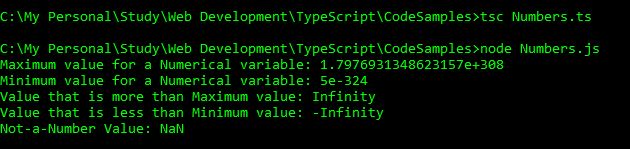
Below is a code to get the above values.

var num=new Number();
console.log("Maximum value for a Numerical variable: " + Number.MAX_VALUE);
console.log("Minimum value for a Numerical variable: " + Number.MIN_VALUE);
console.log("Value that is more than Maximum value: " + Number.POSITIVE_INFINITY);
console.log("Value that is less than Minimum value: " + Number.NEGATIVE_INFINITY);
console.log("Not-a-Number Value: " + Number.NaN);

Below is the output of above code:

prototype in TypeScript

  • It is a static property of the number object.
  • It is used to assign a new properties and methods to an object in the current code.

Below is an example:

    function contact(name:string, phone:number){
        this.name=name;
        this.phone=phone;
    }
    var user1=new contact("Akanksha",9876543210);
    contact.prototype.address="Delhi";
    console.log("Name: " + user1.name);
    console.log("Phone: " + user1.phone);
    console.log("Address: " + user1.address);

Below is the output of above code:

Function Overload in TypeScript

  • We can have a function with same name, but different parameters and different functionality. This is known as Function Overload.
  • We can first declare the functions and then define it.
  • If they differ on the number of parameters, we can mark the parameters as optional during function definition.
  • Please note that this function overloading is different from C# function overloading. There we used to have many function definitions with one function name; but here, we have only one function definition.
  • Based on our inputs, your code will choose which function to invoke.
  • We can differentiate our functions based on
    • Data Types of the parameters
    • Number of Parameters
    • Sequence of Parameters

Below is a sample code

function addition(num1:number, num2:number):void;
function addition(str1:string,str2:string):void;

function addition(a:any, b:any):void{
    console.log(a+b);
}

addition("Hello", " Friends");
addition(10,20);

Below is the output of above code:

Other Related Articles

Functions in TypeScript
Parameterized Functions – Part 1
Parameterized Functions – Part 2

Power Platform Academy

Start or Upgrade your Career with Power Platform

Learn with Akanksha

Python | Azure | AI/ML | OpenAI | MLOps

Design a site like this with WordPress.com
Get started